
Thank you for Subscribing to Insurance Business Review Weekly Brief


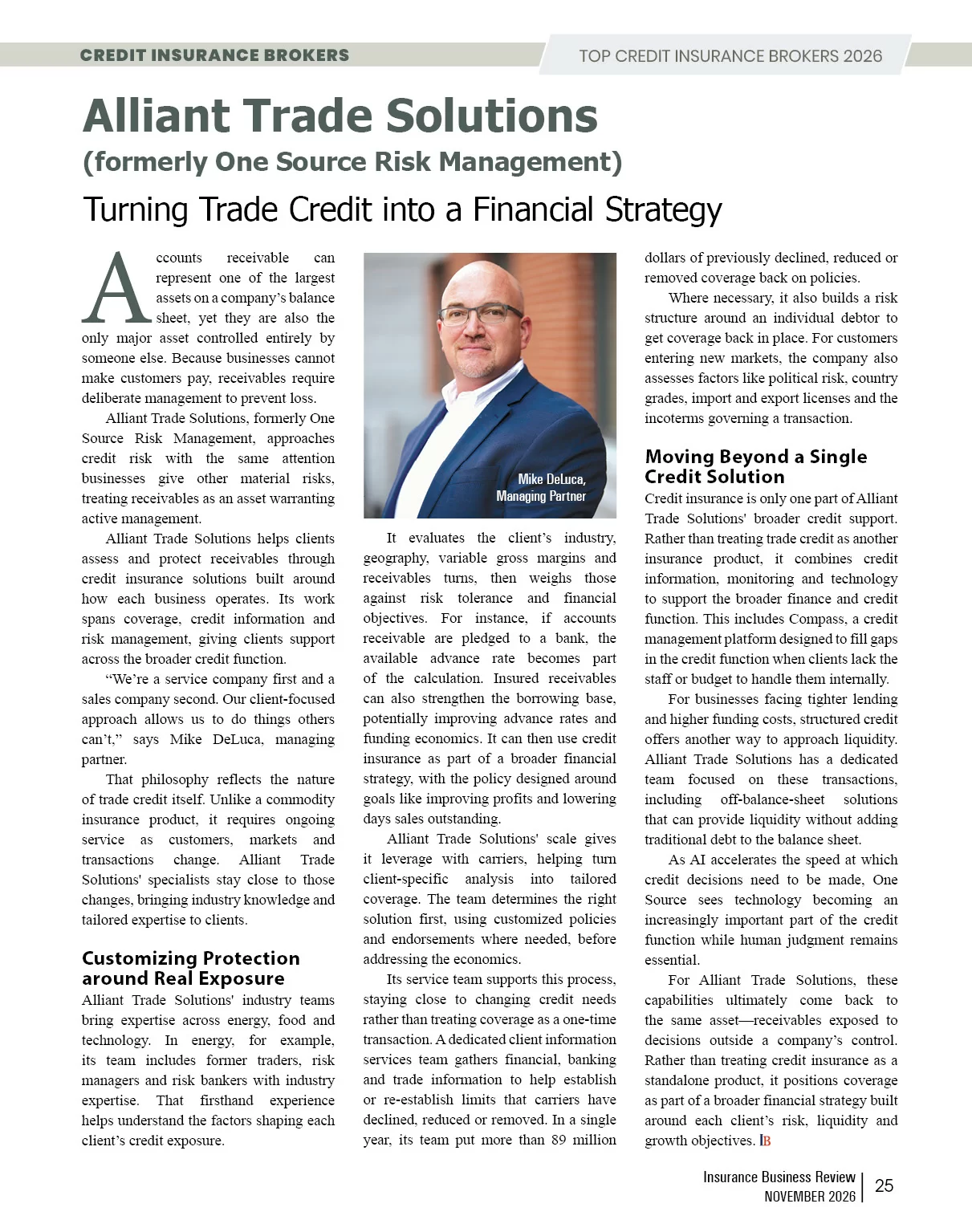
 Mike DeLuca, Managing Partner
Accounts receivable can represent one of the largest assets on a company’s balance sheet, yet they are also the only major asset controlled entirely by someone else. Because businesses cannot make customers pay, receivables require deliberate management to prevent loss.
One Source Risk Management approaches credit risk with the same attention businesses give other material risks, treating receivables as an asset warranting active management.
A division of Alliant Insurance Services, Inc., One Source helps clients assess and protect receivables through credit insurance solutions built around how each business operates. Its work spans coverage, credit information and risk management, giving clients support across the broader credit function.
“We’re a service company first and a sales company second. Our client-focused approach allows us to do things others can’t,” says Mike DeLuca, managing partner.
That philosophy reflects the nature of trade credit itself. Unlike a commodity insurance product, it requires ongoing service as customers, markets and transactions change. One Source’s specialists stay close to those changes, bringing industry knowledge and tailored expertise to clients.
Customizing Protection around Real Exposure
One Source’s industry teams bring expertise across energy, food and technology. In energy, for example, its team includes former traders, risk managers and risk bankers with industry expertise. That firsthand experience helps understand the factors shaping each client’s credit exposure.
It evaluates the client’s industry, geography, variable gross margins and receivables turns, then weighs those against risk tolerance and financial objectives. For instance, if accounts receivable are pledged to a bank, the available advance rate becomes part of the calculation. Insured receivables can also strengthen the borrowing base, potentially improving advance rates and funding economics. It can then use credit insurance as part of a broader financial strategy, with the policy designed around goals like improving profits and lowering days sales outstanding.
-
We’re a service company first and a sales company second. Our client-focused approach allows us to do things others can’t.
One Source’s scale gives it leverage with carriers, helping turn client-specific analysis into tailored coverage. The team determines the right solution first, using customized policies and endorsements where needed, before addressing the economics.
Its service team supports this process, staying close to changing credit needs rather than treating coverage as a one-time transaction. A dedicated client information services team gathers financial, banking and trade information to help establish or re-establish limits that carriers have declined, reduced or removed. In a single year, its team put more than 89 million dollars of previously declined, reduced or removed coverage back on policies.
Where necessary, it also builds a risk structure around an individual debtor to get coverage back in place. For customers entering new markets, the company also assesses factors like political risk, country grades, import and export licenses and the incoterms governing a transaction.
Moving Beyond a Single Credit Solution
Credit insurance is only one part of One Source’s broader credit support. Rather than treating trade credit as another insurance product, it combines credit information, monitoring and technology to support the broader finance and credit function. This includes Compass, a credit management platform designed to fill gaps in the credit function when clients lack the staff or budget to handle them internally.
For businesses facing tighter lending and higher funding costs, structured credit offers another way to approach liquidity. One Source has a dedicated team focused on these transactions, including off-balance-sheet solutions that can provide liquidity without adding traditional debt to the balance sheet.
As AI accelerates the speed at which credit decisions need to be made, One Source sees technology becoming an increasingly important part of the credit function while human judgment remains essential.
For One Source, these capabilities ultimately come back to the same asset— receivables exposed to decisions outside a company’s control. Rather than treating credit insurance as a standalone product, it positions coverage as part of a broader financial strategy built around each client’s risk, liquidity and growth objectives.
Credit Insurance Brokers Info
Q1
What Do Credit Insurance Brokers Help Businesses Protect Against?
Unpaid invoices can impede cash flow and lock up working capital if clients fail to pay for goods or services. By setting up insurance for qualified losses in accordance with the provisions of the policy, credit insurance brokers assist in managing this risk. Offering credit to clients without taking on all the risk may be made simpler by this protection. When drafting a policy, brokers also examine receivables and evaluate coverage possibilities while taking the company's financial status into account.
Q2
How Does One Source Risk Management Approach Credit Insurance?
Credit protection involves more than choosing an insurance policy. One Source Risk Management combines credit insurance, credit information and risk management to address receivables exposure. When developing coverage, the firm considers industry conditions, geographic exposure, gross margins and receivables turnover. Its specialists also account for lending arrangements and financial objectives, connecting policy decisions to working capital requirements and the financial implications of extending customer credit.
Q3
What Should Businesses Consider When Choosing Credit Insurance Brokers?
The right broker should understand a business’s sales model, customer payment patterns and tolerance for financial loss. Premiums deserve attention, but coverage limits, exclusions, endorsements and the treatment of individual debtors can matter just as much. Industry knowledge and access to suitable insurance markets are also important. Businesses should expect clear explanations of how policy terms apply to actual transactions, particularly when a customer’s financial position changes or an insurer revises a credit limit.
Q4
How Can Credit Insurance Support Financing and Cash Flow?
When lenders evaluate security and borrowing bases, insured receivables may help companies keep access to funding. Credit Insurance Brokers can assist in determining whether a policy aligns with cash flow goals and current lending agreements. The conditions of the coverage, the lender's criteria, and the financial situation of the company all affect the advantages. Examining these elements collectively makes it clear whether credit insurance may support liquidity while lowering vulnerability to customer nonpayment. Rather than being taken into consideration independently, the policy must be compatible with the finance system.
Q5
How Can Brokers Help Restore Reduced or Declined Credit Limits?
When an insurer reduces or declines a buyer’s credit limit, additional information may help clarify the buyer’s financial position. Credit Insurance Brokers can assist by gathering financial, banking and trade information for the insurer’s review. One Source Risk Management has a dedicated Client Information Services team that pursues limits carriers have declined, reduced or removed. In a single year, the team restored more than $89 million in previously restricted coverage to policies. That result shows how detailed credit information can help address limits that constrain insured receivables.
Q6
What Services Matter Beyond a Credit Insurance Policy?
Insurance is only one part of managing customer credit. Businesses may also need credit reports, buyer monitoring, receivables support and tools for handling credit decisions when internal resources are limited. Credit Insurance Brokers familiar with these connected functions can help businesses assess how insurance fits their wider credit processes. One Source Risk Management also provides credit information and receivables management, alongside Compass, a credit management platform designed to address gaps in internal credit functions. These services can inform decisions about customer exposure, collections and available liquidity.
Company : Alliant Trade Solutions (formerly One Source Risk Management)
ManagementMike DeLuca, Managing Partner