

Thank you for Subscribing to Insurance Business Review Weekly Brief


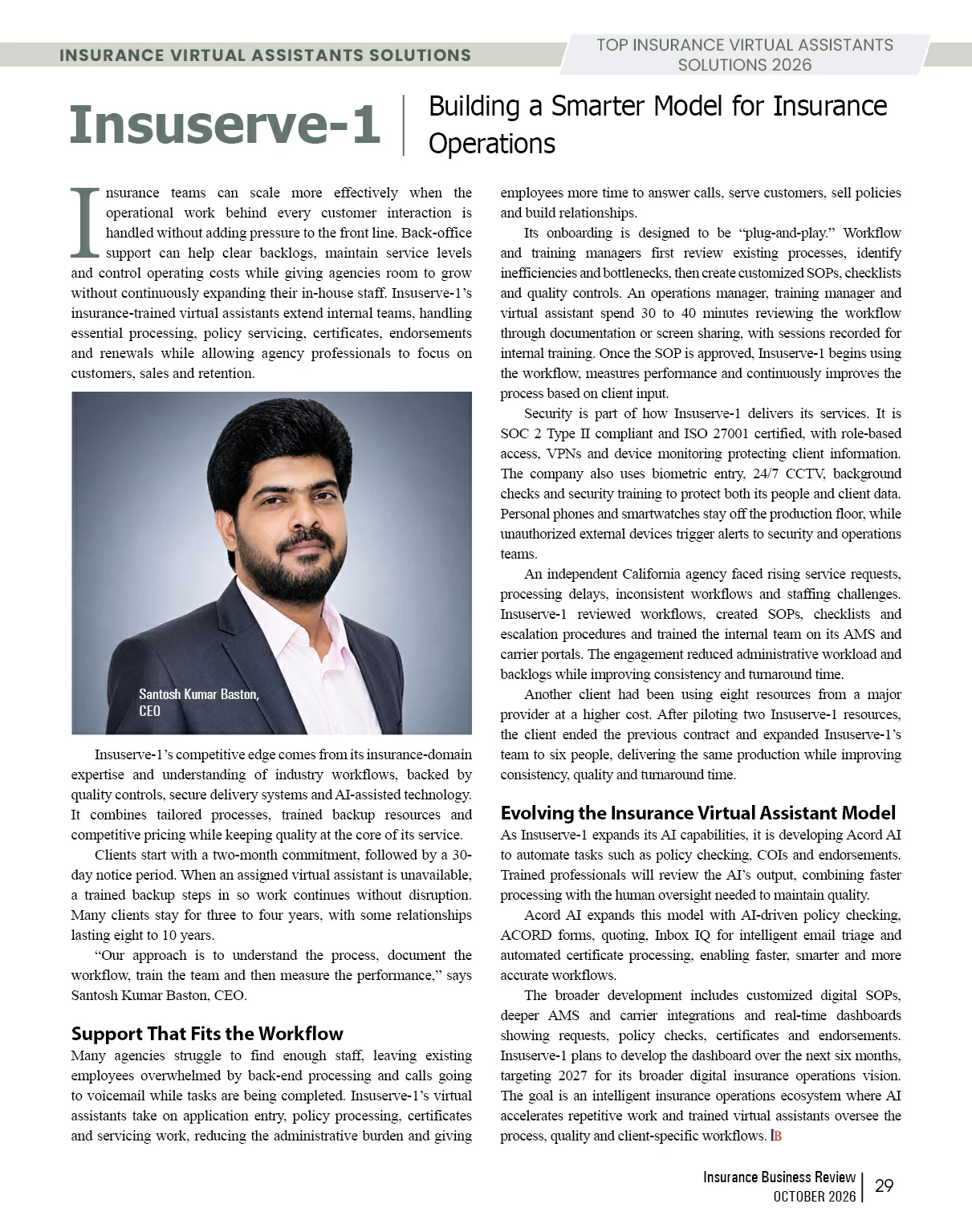
 Santosh Kumar Baston, CEO
Insurance teams can scale more effectively when the operational work behind every customer interaction is handled without adding pressure to the front line. Back-office support can help clear backlogs, maintain service levels and control operating costs while giving agencies room to grow without continuously expanding their in-house staff. Insuserve-1’s insurance-trained virtual assistants extend internal teams, handling essential processing, policy servicing, certificates, endorsements and renewals while allowing agency professionals to focus on customers, sales and retention.
Insuserve-1’s competitive edge comes from its insurance-domain expertise and understanding of industry workflows, backed by quality controls, secure delivery systems and AI-assisted technology. It combines tailored processes, trained backup resources and competitive pricing while keeping quality at the core of its service.
Clients start with a two-month commitment, followed by a 30- day notice period. When an assigned virtual assistant is unavailable, a trained backup steps in so work continues without disruption. Many clients stay for three to four years, with some relationships lasting eight to 10 years.
“Our approach is to understand the process, document the workflow, train the team and then measure the performance,” says Santosh Kumar Baston, CEO.
Support That Fits the Workflow
Many agencies struggle to find enough staff, leaving existing employees overwhelmed by back-end processing and calls going to voicemail while tasks are being completed. Insuserve-1’s virtual assistants take on application entry, policy processing, certificates and servicing work, reducing the administrative burden and giving employees more time to answer calls, serve customers, sell policies and build relationships.
-
Our approach is to understand the process, document the workflow, train the team and then measure the performance.
Its onboarding is designed to be “plug-and-play.” Workflow and training managers first review existing processes, identify inefficiencies and bottlenecks, then create customized SOPs, checklists and quality controls. An operations manager, training manager and virtual assistant spend 30 to 40 minutes reviewing the workflow through documentation or screen sharing, with sessions recorded for internal training. Once the SOP is approved, Insuserve-1 begins using the workflow, measures performance and continuously improves the process based on client input.
Security is part of how Insuserve-1 delivers its services. It is SOC 2 Type II compliant and ISO 27001 certified, with role-based access, VPNs and device monitoring protecting client information. The company also uses biometric entry, 24/7 CCTV, background checks and security training to protect both its people and client data. Personal phones and smartwatches stay off the production floor, while unauthorized external devices trigger alerts to security and operations teams.
An independent California agency faced rising service requests, processing delays, inconsistent workflows and staffing challenges. Insuserve-1 reviewed workflows, created SOPs, checklists and escalation procedures and trained the internal team on its AMS and carrier portals. The engagement reduced administrative workload and backlogs while improving consistency and turnaround time.
Another client had been using eight resources from a major provider at a higher cost. After piloting two Insuserve-1 resources, the client ended the previous contract and expanded Insuserve-1’s team to six people, delivering the same production while improving consistency, quality and turnaround time.
Evolving the Insurance Virtual Assistant Model
As Insuserve-1 expands its AI capabilities, it is developing Acord AI to automate tasks such as policy checking, COIs and endorsements. Trained professionals will review the AI’s output, combining faster processing with the human oversight needed to maintain quality.
Acord AI expands this model with AI-driven policy checking, ACORD forms, quoting, Inbox IQ for intelligent email triage and automated certificate processing, enabling faster, smarter and more accurate workflows.
The broader development includes customized digital SOPs, deeper AMS and carrier integrations and real-time dashboards showing requests, policy checks, certificates and endorsements. Insuserve-1 plans to develop the dashboard over the next six months, targeting 2027 for its broader digital insurance operations vision. The goal is an intelligent insurance operations ecosystem where AI accelerates repetitive work and trained virtual assistants oversee the process, quality and client-specific workflows.
Insurance Virtual Assistants that Protect Selling Time
Insurance agencies can add more revenue-producing staff and still find that too much of their time is spent handling certificates of insurance, endorsements, renewals and policy-processing queues. The issue is not simply how many people an agency has on staff. It is how those licensed employees spend their working day. When service tasks take up hours that could have gone toward answering clients, discussing coverage or protecting renewals, staffing costs can start pulling the agency away from its real commercial priorities.
That is why virtual assistant services are better judged by the insurance work they can reliably take off the internal queue, not just by how much labor they can provide. General administrative outsourcing often misses the mark because insurance servicing relies on carrier portals, agency management systems, policy terminology and procedures that vary from one agency to another. A provider may be able to supply staff quickly, but that does not help much if each new resource needs extensive training or if the quality of the work varies between people.
The way a provider fits into an agency’s existing processes also deserves a close look. Agencies do not necessarily handle servicing requests the same way, even when they use the same management system. A stronger service model should be able to work with the agency’s existing workflow, document it clearly and put checks in place around the areas where requests tend to stall or mistakes happen repeatedly. Buyers should look for evidence that onboarding is built around the agency’s actual procedures rather than a standard template. Continuity matters too. Relying on one assigned assistant creates another point of vulnerability if that person is sick or away, so backup staffing should already be part of the service rather than arranged only after a gap occurs.
The commercial terms can create problems of their own. Long-term commitments can be hard to justify when an agency’s workload rises and falls with renewal cycles and changing hiring needs. Buyers should understand how easily staffing can be increased or reduced and what happens if a dedicated resource is suddenly unavailable. Documentation matters here as well. Procedures should remain clear and consistent even when the people supporting the account change. Flexibility is not much use if every staffing change means the agency has to start the training process all over again.
“Insuserve-1's teams support back-office work that includes policy processing, certificates of insurance, endorsements and renewals while adapting procedures to the agency’s existing systems.”
Data control deserves the same level of attention. Outsourced teams may work with policy records, credentials and client information through external processing environments, so buyers need to understand how that information is protected in practice. Certifications provide useful assurance, but they do not answer every day-to-day security question. Access controls, managed devices, monitored endpoints and disciplined offboarding tell buyers more about how exposure is actually managed. Agencies should also understand whether staff can use personal devices or attempt to move information to external storage. What happens to employee access when someone changes roles should be examined separately.
Automation introduces another consideration. Buyers should be wary of services that focus on cutting visible staffing numbers while leaving exceptions and quality checks unresolved. Insurance work still involves judgment, and carrier requirements can differ from one case to another. Documents can vary too, which adds another layer of complexity. A more useful approach is to let software handle repetitive processing while trained staff remain responsible for reviewing the work and dealing with exceptions. That can improve throughput without requiring the agency to give up control simply to gain speed.
Insuserve-1 fits this model with an insurance-focused virtual assistant service built around documented client workflows and trained backup resources. Its teams handle back-office work including policy processing, certificates of insurance, endorsements and renewals while adapting their procedures to the agency’s existing systems. Its security controls include SOC 2 Type II compliance, ISO 27001 certification, role-based access and managed-device monitoring. Its Accord AI, which is currently under development, is intended to automate repetitive tasks such as data entry, document classification and policy checking, with virtual assistants reviewing the completed work before it is delivered. For agencies looking to free licensed staff for client contact without adding more internal processing staff, Insuserve-1 is worth serious consideration.
...Read more
Insurance Virtual Assistant Solutions Info
Q1
What Do Insurance Virtual Assistant Solutions Typically Cover?
Insurance Virtual Assistant Solutions can take on recurring administrative and service work that depends on accuracy, consistency and timely completion. Typical tasks include application entry, certificate processing, policy checking, endorsements, renewals and other forms of policy servicing. The aim is not simply to shift work elsewhere. A sound model uses documented procedures, quality checks and trained support so internal staff can spend more time on customer communication, sales and account relationships without letting routine processing slip.
Q2
How Does Insuserve Apply Virtual Assistance to Insurance Operations?
Insurance Virtual Assistant Solutions provide trained virtual assistants to assist in core insurance processing, for Insuserve. Its staff processes certificates, endorsements and renewals, as well as processes applications. As part of the onboarding process, workflow managers examine current processes; write workflow-specific SOPs, checklists and quality controls prior to work. Insuserve also maintains qualified backup staff in its wake up procedures when a primary VA is not there to help with the daily processing and limit the possibility of avoidable gaps in the handoff.
Q3
What Problems Can Virtual Support Help Insurance Teams Address?
Insurance Virtual Assistant Solutions are most helpful when the volume of routine work begins to compete with work that is handled by the customer. Internal employees can get distracted from calls, account services and relationship management due to repetitive work or backlogs and uneven workloads. The insurance back-office support provides the processing work with a defined place and provides points of review and documented steps. The actual advantage is when teams get more capacity and still have the same service consistency and turnaround as before when volumes increase.
Q4
Which Quality and Security Factors Matter When Evaluating Insurance Virtual Assistant Solutions?
Insurance Virtual Assistant Solutions should be judged on more than staffing availability or price. Buyers should look closely at training, workflow controls, quality review, access management, business continuity and data protection. Clear SOPs and measurable standards help keep recurring work consistent. Security deserves equal attention because insurance processing can involve sensitive customer and policy information. Controlled system access, monitored devices, secure connectivity and documented handling procedures are the kinds of safeguards that matter in daily use.
Q5
How Can Virtual Assistants Support Consistent Policy Servicing?
Insurance Virtual Assistant Solutions can normalize policy servicing by scheduling repeatable tasks for trained staff and staff that adhere to a set of procedures. Clear handoffs and regular review benefit policy checking, certificate handling, endorsements, cancellations, renewals and data entry. A structured workflow also facilitates exceptions to be identified and escalated. That could be reduced backlogs for internal teams, consistent turnaround and less time spent chasing routine tasks that should already be moving through the process.
Q6
How Is Insuserve Combining Automation with Human Review?
Insuserve is extending Insurance Virtual Assistant Solutions with AI-assisted tools while keeping trained people in the review loop. Its Acord AI development covers policy checking, ACORD forms, quoting, email triage and automated certificate processing. It is also developing deeper agency management system and carrier integrations alongside real-time dashboards. Insuserve’s model keeps human quality review alongside automation, so faster processing does not come at the cost of oversight on work that still requires judgment and verification.
